

Breaking Into the NGO Sector Without Experience: Proven Strategies for Entry-Level Candidates.
Introduction
The non-governmental organisation sector presents a paradox for aspiring professionals: organisations consistently seek experienced candidates, yet gaining that initial experience without prior NGO employment proves remarkably challenging. This catch-22 situation frustrates countless individuals passionate about humanitarian work, international development, or social change who face repeated rejection due to insufficient sector-specific experience.
However, breaking into the NGO sector without traditional experience remains achievable through strategic approaches, creative positioning of transferable skills, and understanding alternative pathways that organisations value. The sector's competitive nature demands candidates think innovatively about demonstrating commitment, building relevant capabilities, and positioning themselves effectively for entry-level opportunities.
This comprehensive guide provides proven strategies specifically designed for candidates without NGO experience who seek to establish careers in the third sector. Whether you are a recent graduate, career changer from the private or public sector, or professional seeking purpose-driven work, this article delivers actionable guidance to overcome experience barriers and successfully enter the NGO sector.
Understanding What NGOs Value Beyond Direct Experience
Non-governmental organisations value a broader range of attributes than job descriptions often suggest. Whilst postings frequently list experience requirements, successful candidates without direct NGO backgrounds regularly secure positions by demonstrating qualities organisations genuinely need.
NGOs prioritise candidates who exhibit genuine commitment to their mission and values. This commitment manifests through volunteer work, personal projects addressing social issues, participation in advocacy campaigns, or demonstrated engagement with causes aligned with organisational objectives. Hiring managers recognise that passionate, mission-aligned candidates often outperform those with extensive but uncommitted experience.
Transferable skills from other sectors prove highly valuable in NGO contexts. Project management capabilities developed in corporate environments translate directly to programme coordination roles. Communication skills honed in marketing or public relations apply to NGO advocacy and fundraising functions. Financial management experience from any sector supports NGO finance and grants management positions. Data analysis skills from research or business contexts enable monitoring and evaluation work.
Cultural competence and adaptability matter significantly, particularly for international development organisations. Candidates who demonstrate cross-cultural understanding through travel, language learning, international education, or multicultural environments possess qualities difficult to teach but essential for effective development work.
Problem-solving abilities and resourcefulness reflect the reality of NGO operations, where budgets remain constrained and creative solutions prove necessary. Candidates who demonstrate initiative, adaptability, and ability to achieve results with limited resources align well with sector demands.
Strategic Volunteering as Your Entry Point
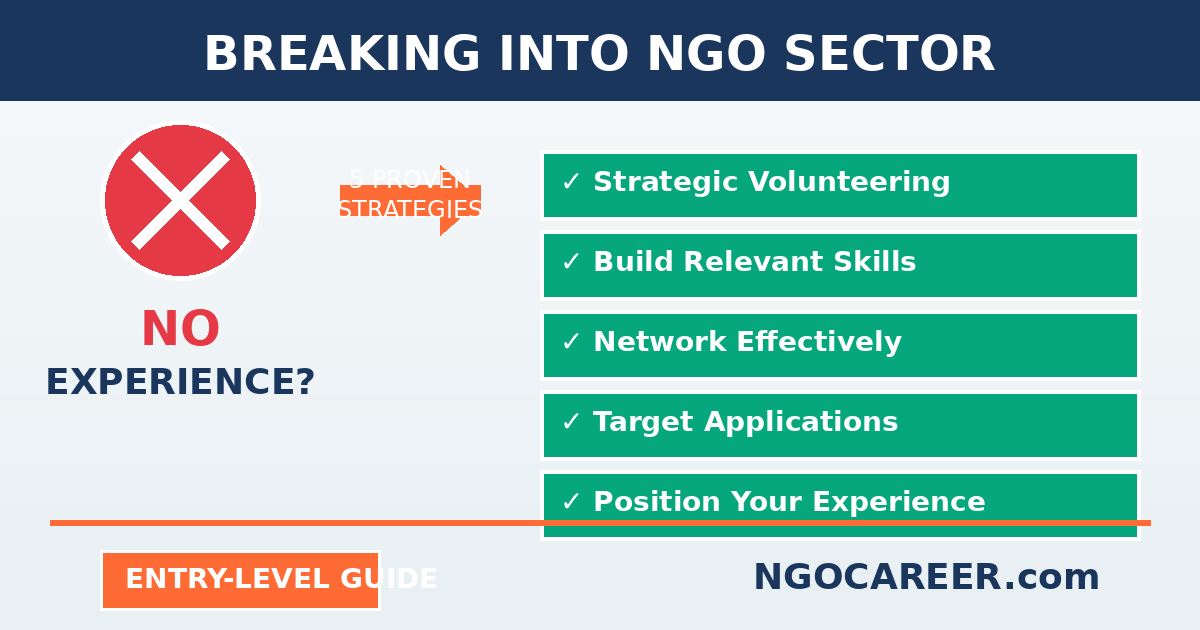
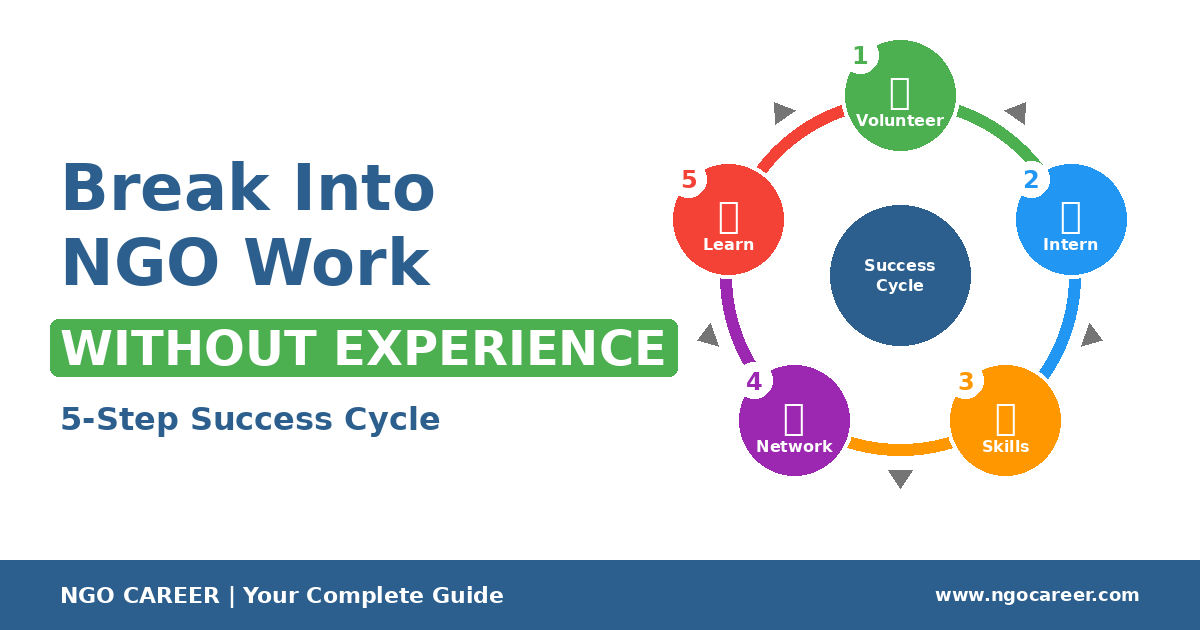
Volunteering represents the most accessible pathway into the NGO sector for candidates without paid experience, provided it is approached strategically rather than casually. Effective volunteering requires selectivity, clear objectives, and focus on building demonstrable skills and connections.
Choose volunteer opportunities that align with your target career path within the sector. If you seek programme management roles, volunteer for organisations where you can contribute to project planning, implementation, or monitoring rather than solely administrative tasks. For communications careers, seek volunteer positions involving content creation, social media management, or stakeholder engagement.
Structure your volunteering to build specific competencies valued by employers. Request clearly defined roles with responsibilities you can articulate in applications and interviews. Document your achievements, maintaining records of projects completed, outcomes achieved, and skills developed. Quantify your contributions wherever possible, noting beneficiaries reached, funds raised, or programmes delivered.
Long-term, consistent volunteering demonstrates greater commitment than sporadic involvement with multiple organisations. Maintaining a sustained relationship with one or two organisations over months or years builds deeper experience, stronger references, and genuine understanding of NGO operations that resonates more powerfully with employers than brief engagements with numerous charities.
International volunteering programmes through established schemes like VSO, Peace Corps, or UN Volunteers provide immersive experiences highly valued by employers. These structured programmes offer training, support, and credible frameworks that differentiate them from potentially exploitative voluntourism arrangements. However, candidates should carefully research programmes to ensure ethical practices and genuine benefit to host communities.
Domestic volunteering proves equally valuable and often more accessible. Local charities, community organisations, refugee support services, homeless shelters, and advocacy groups offer meaningful opportunities to develop relevant skills whilst contributing to important causes. This approach also demonstrates commitment to social impact beyond the appeal of international travel.
Leveraging Internships and Fellowships
Internships with established NGOs provide structured pathways for candidates seeking to gain sector experience and demonstrate capability. Whilst many internships offer minimal or no compensation, they deliver professional development, mentorship, networking opportunities, and credible experience that strengthens subsequent applications for paid positions.
Target internship programmes with reputable organisations that offer genuine learning opportunities, supervision, and clearly defined projects rather than exploitative arrangements involving only menial tasks. Research organisations' reputations, speak with former interns when possible, and assess whether programmes provide meaningful skill development.
Fellowship programmes specifically designed for early-career professionals offer intensive, supported experiences often including stipends or living allowances. Programmes such as those offered by major international NGOs, foundations, or sector bodies provide cohort-based learning, professional development, and often lead to employment opportunities within host organisations or the broader sector.
Graduate schemes run by larger NGOs offer structured entry routes combining rotations across departments, formal training, and mentorship. These competitive programmes specifically target recent graduates, making lack of prior NGO experience less problematic than for standard recruitment processes.
Consider unpaid internships strategically and ethically. Whilst such arrangements may provide valuable experience, they perpetuate inequity by favouring candidates with financial resources to work without compensation. If pursuing unpaid opportunities, seek part-time arrangements allowing concurrent paid employment, apply for programmes offering modest stipends or expenses, or time-limit unpaid work to specific, achievable objectives before transitioning to paid roles or alternative opportunities.
Building Relevant Skills Through Alternative Pathways
Professional development outside direct NGO employment strengthens candidacy significantly. Online courses through platforms like Coursera, edX, or FutureLearn offer certifications in areas highly valued by NGOs including project management, monitoring and evaluation, humanitarian principles, sustainable development, and sector-specific technical skills.
Project management qualifications such as PRINCE2 or PMD Pro (Project Management for Development Professionals) demonstrate concrete capabilities applicable across numerous NGO roles. These credentials signal commitment to professional standards and provide frameworks directly relevant to programme delivery.
Language skills dramatically enhance employability, particularly for international development positions. French, Spanish, Arabic, Portuguese, and Mandarin prove especially valuable. Even conversational proficiency demonstrates cultural engagement and facilitates field-based work, whilst advanced fluency opens opportunities in specific geographic regions.
Writing and communication skills development through blogging about development issues, contributing to online publications, or creating content addressing social challenges builds portfolios demonstrating capability alongside passion for sector themes. Published work, even on personal platforms, provides tangible evidence of communication abilities and subject knowledge.
Technical skills in data analysis, research methodologies, or digital tools used by NGOs strengthen applications. Familiarity with tools like SPSS for statistical analysis, GIS for mapping and spatial analysis, or platforms like Salesforce commonly used by charities differentiates candidates in competitive recruitment processes.
Networking Strategically Within the Sector
Professional networking proves crucial for accessing opportunities in the relatively close-knit NGO community where many positions fill through personal connections before public advertising. Strategic networking involves genuine relationship-building rather than transactional job-seeking.
Attend sector events, conferences, webinars, and professional gatherings to meet practitioners, learn about organisations, and demonstrate engagement with sector issues. Many events offer reduced rates or free attendance for students or early-career professionals. Virtual events have increased accessibility, removing geographic and financial barriers to participation.
Join professional associations relevant to your target area within the sector. Organisations like BOND (British Overseas NGOs for Development), Institute of Fundraising, or International Association for Development Evaluation provide networking platforms, professional development, and job boards specifically for members.
Utilise LinkedIn strategically by following organisations and thought leaders, engaging thoughtfully with content, and sharing insights demonstrating your knowledge and commitment. Maintain a professional profile clearly articulating your skills, interests, and sector engagement. Connect with NGO professionals respectfully, personalising connection requests and avoiding aggressive job-seeking approaches.
Conduct informational interviews with professionals in roles or organisations you aspire to join. Most sector practitioners respond positively to genuine, respectful requests for advice and insight. These conversations provide valuable guidance, help you understand realistic pathways, and potentially lead to opportunities when positions arise.
Alumni networks from universities or professional programmes connect you with others who share educational backgrounds and often maintain sector-specific groups or mentorship schemes supporting career development.
Positioning Your Experience Effectively
Candidates without NGO experience must strategically position their backgrounds to resonate with sector employers. This requires translating experiences from other contexts into language and frameworks familiar to NGO recruiters whilst demonstrating genuine commitment to mission-driven work.
Corporate experience can be reframed to highlight relevant capabilities. Business analysis becomes needs assessment and context analysis. Sales and marketing translate to fundraising and stakeholder engagement. Supply chain management aligns with humanitarian logistics. Human resources experience supports NGO capacity building and organisational development.
Public sector backgrounds offer particularly strong foundations for NGO work, as both environments involve navigating complex stakeholder relationships, operating within budget constraints, and pursuing public benefit rather than profit. Civil servants transitioning to NGOs should emphasise policy development, programme management, and accountability frameworks familiar to both sectors.
Academic backgrounds position candidates for research, policy, and technical advisory roles. Postgraduate qualifications in development studies, international relations, public health, or related fields combined with strong research and analytical skills attract organisations seeking evidence-based programming and thought leadership.
Personal experiences including living abroad, cultural immersion, language learning, or involvement with marginalised communities demonstrate qualities difficult to develop through formal education alone. These experiences, when reflected upon thoughtfully, illustrate cultural sensitivity and commitment to inclusive development.
Craft compelling narratives explaining your transition to the NGO sector. Hiring managers appreciate candidates who can articulate why they seek this career change, what motivates their commitment to specific causes, and how their previous experiences prepare them for NGO work despite lacking direct sector experience.
Targeting Your Applications Strategically
Strategic targeting of applications significantly improves success rates compared to scatter-gun approaches. Focus efforts on opportunities where your profile aligns best with organisational needs, even without perfect experience matches.
Smaller and medium-sized NGOs often prove more accessible for candidates without extensive experience than large, prestigious international organisations. These organisations may offer greater flexibility in hiring, more diverse responsibilities enabling rapid skill development, and closer engagement with senior staff providing mentorship opportunities.
Consider roles slightly adjacent to your ultimate target that may require less experience whilst building relevant capabilities. Fundraising assistant positions often welcome candidates from sales or customer service backgrounds. Communications roles may suit journalists or marketing professionals. Research assistant positions fit recent graduates with strong analytical skills.
Geographic flexibility dramatically increases opportunities. Candidates willing to work in challenging locations, accept field-based postings, or relocate to regions with less competitive job markets access positions unavailable to those limiting searches to desirable cities like London.
Tailoring applications meticulously to each position and organisation proves essential. Generic CVs and cover letters rarely succeed in the competitive NGO sector. Research organisations thoroughly, understand their strategic priorities and recent work, and explicitly connect your capabilities to their specific needs and values.
Address experience gaps directly and positively in cover letters. Acknowledge lacking traditional NGO background but emphasise relevant transferable skills, demonstrated commitment through volunteering or other engagement, and specific reasons why you seek to contribute to this organisation's mission.
Challenges and Opportunities in Entry-Level NGO Careers
Candidates must approach NGO careers with realistic expectations about both opportunities and challenges. The sector offers meaningful work contributing to social good, diverse experiences, continuous learning, and connections with passionate colleagues. However, entry poses genuine difficulties requiring persistence and strategic navigation.
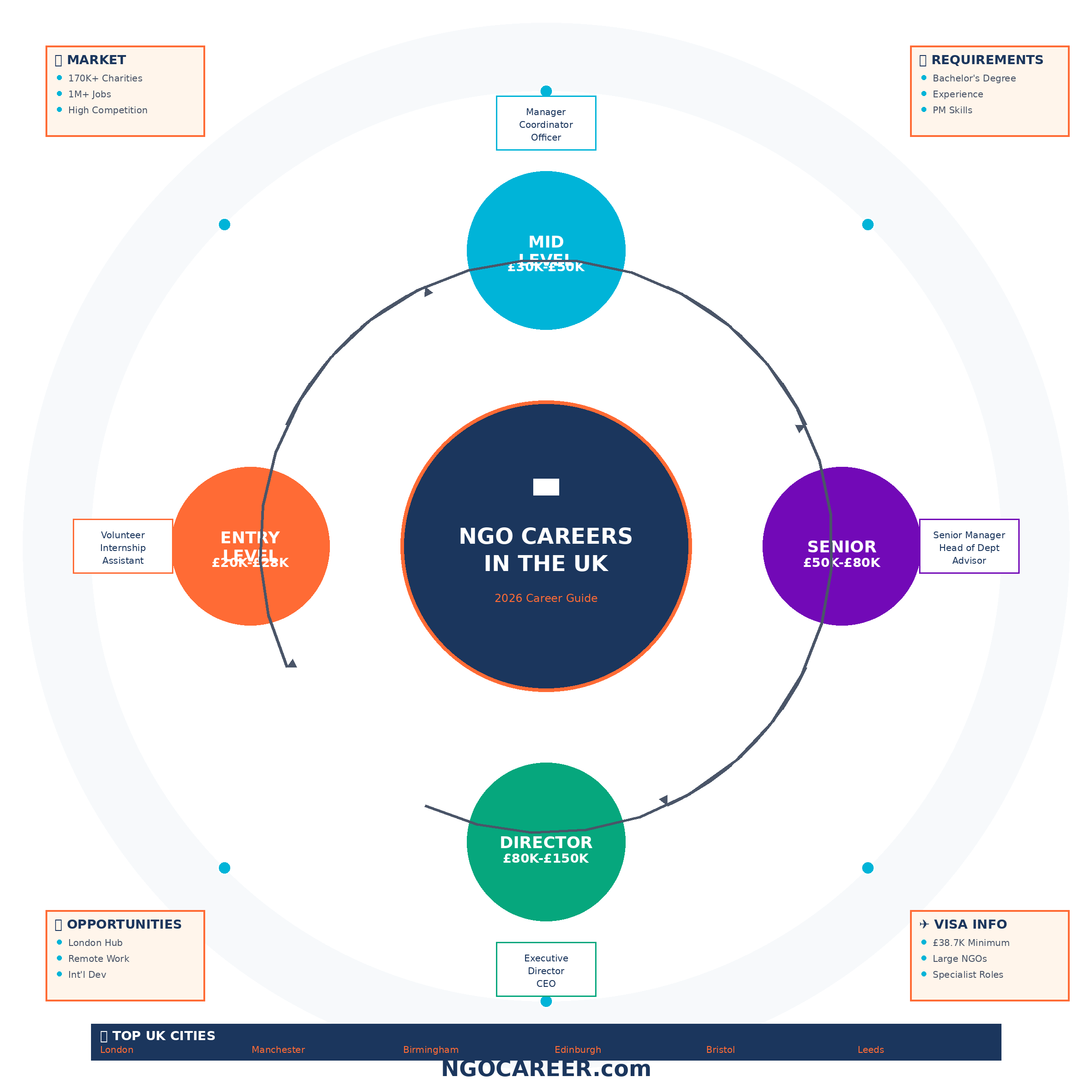
Financial challenges affect many aspiring NGO professionals. Entry-level salaries often fall below private sector equivalents, voluntary or low-paid initial experiences may be necessary to gain credibility, and precarious short-term contracts characterise early career stages. Candidates should plan financially for potentially modest initial earnings and periods between contracts.
Competition remains intense, particularly for prestigious organisations and desirable locations. Successful entry often requires patience, multiple applications, and willingness to accept imperfect initial opportunities that provide stepping stones to preferred roles.
The sector continues evolving, with increasing emphasis on localisation, decolonising aid, and strengthening civil society in the Global South. Future opportunities will likely focus more on supporting locally-led development rather than expatriate-led programmes, requiring different skill sets emphasising partnership, capacity building, and humility.
Conclusion
Breaking into the NGO sector without traditional experience presents genuine challenges but remains achievable through strategic approaches combining skill development, creative positioning of transferable capabilities, and persistent engagement with sector communities. Success requires viewing your entry pathway as a medium-term journey rather than immediate transition, building experience incrementally through volunteering, internships, and targeted applications whilst developing relevant competencies and networks.
The sector needs talented, committed professionals from diverse backgrounds bringing fresh perspectives and capabilities. Your non-traditional pathway may ultimately strengthen your contribution by offering insights and approaches that sector veterans sometimes lack. Maintain confidence in your transferable skills whilst demonstrating humility and genuine commitment to learning sector-specific knowledge and practices.
Persistence proves essential. Rejection characterises most candidates' experiences before successfully entering the sector. Each application, interview, and networking conversation builds knowledge and connections that eventually lead to opportunities. The professionals who successfully break into the NGO sector without prior experience consistently demonstrate resilience, adaptability, and unwavering commitment to their goals.
Frequently Asked Questions
How long does it typically take to break into the NGO sector without experience?
Most candidates require six months to two years of strategic effort including volunteering, skill development, networking, and targeted applications before securing their first paid NGO position. This timeline varies based on individual circumstances, geographic flexibility, target organisations, and persistence. Maintaining realistic expectations helps sustain motivation through the process.
Should I volunteer unpaid if I cannot afford to work without salary?
Unpaid work perpetuates inequity in the sector and should be approached cautiously. If pursuing unpaid opportunities, seek part-time arrangements allowing concurrent paid employment, target short-term commitments with clear objectives and timeframes, or explore programmes offering modest stipends or living allowances. Never accept exploitative arrangements or indefinite unpaid work.
Which skills matter most for breaking into the sector?
Project management, communication and writing, research and analysis, fundraising and grant writing, monitoring and evaluation, and cultural competence consistently rank as highly valued capabilities. Language skills significantly enhance competitiveness. Focus development efforts on these areas through courses, volunteering, or self-directed learning.
Do I need a master's degree to work in NGOs?
Whilst postgraduate qualifications strengthen applications and prove increasingly common for competitive positions, they are not universally required, particularly for entry-level roles. Practical experience often matters as much as advanced degrees. Assess whether additional education serves your specific goals before committing time and resources.
How important is international experience for NGO careers?
International experience enhances applications, especially for development organisations working globally, but domestic experience with marginalised communities, cross-cultural contexts, or development issues proves equally valuable. Many successful NGO careers begin with local engagement before progressing to international roles.
What is the biggest mistake candidates without experience make?
Applying only to prestigious international organisations whilst overlooking smaller NGOs, focusing exclusively on international roles whilst dismissing domestic opportunities, failing to build sector networks and relationships, and inadequately researching organisations before applying consistently hinder candidates. Strategic, targeted approaches outperform volume-based application strategies.
References
Banks, N., Hulme, D. and Edwards, M. (2015) 'NGOs, States, and Donors Revisited: Still Too Close for Comfort?', World Development, 66, pp. 707-718.
Hailey, J. and James, R. (2004) 'Trees Die from the Top: International Perspectives on NGO Leadership Development', Voluntas: International Journal of Voluntary and Nonprofit Organizations, 15(4), pp. 343-353.
ICAI (2022) A Review of Career Pathways in UK Aid. London: Independent Commission for Aid Impact.
Lewis, D. (2014) Non-Governmental Organizations, Management and Development. 3rd edn. Abingdon: Routledge.
NCVO (2023) UK Civil Society Almanac 2023. London: National Council for Voluntary Organisations.
Shutt, C. (2021) 'Professionalisation and Localisation: A False Dichotomy for Development Practice?', Development in Practice, 31(8), pp. 1045-1057.





Leave a Reply
Required fields are marked *